Introduction
In the Gaza Strip, the thing a journalist needs most amidst war is not just courage, but the ability to move.
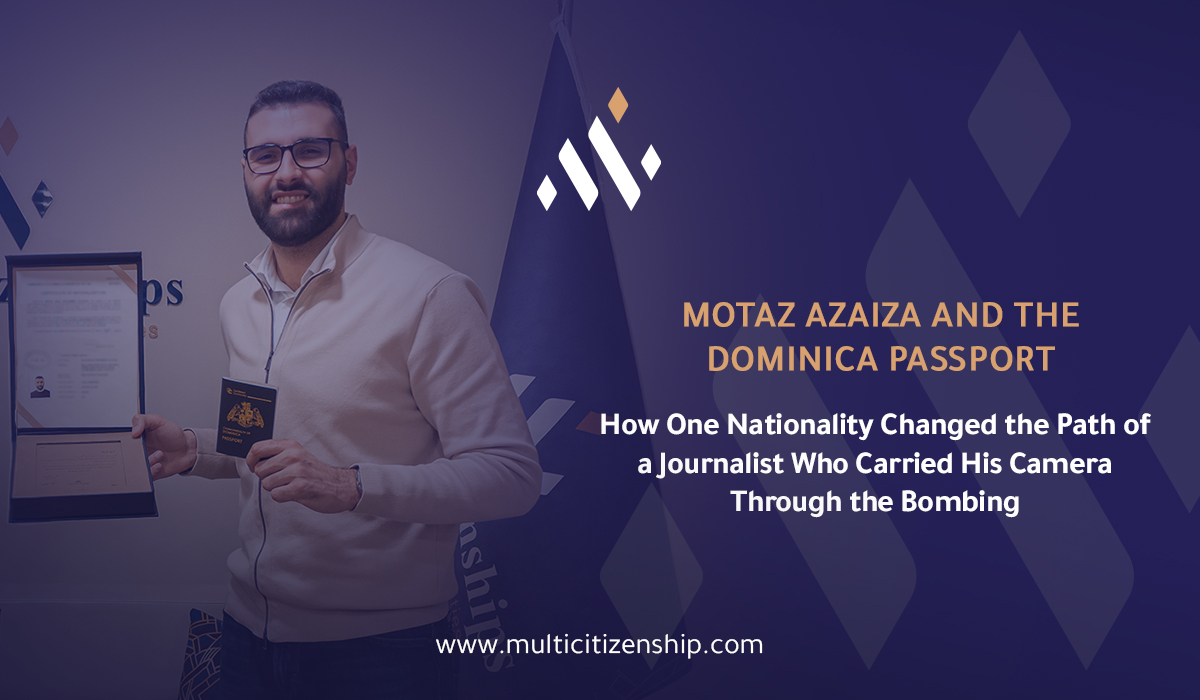
To go out, to convey the image, to reach a global platform, and to complete your mission even after the war leaves you without a home or a family. This is exactly what Motaz Azaiza experienced—the Palestinian journalist whose name became synonymous with documenting the war on Gaza from the inside—and this is precisely what changed in his life when he obtained the citizenship of the Commonwealth of Dominica.
A Journey That Began by Stepping Out from Under the Fire
In January 2024, Motaz Azaiza was evacuated from Gaza to Egypt, and then to Doha. He had just concluded 108 days of documenting, moment by moment, what was happening in the Strip through his camera and his Instagram account, which was followed by millions around the world.
But leaving Gaza was not the end of the journey; rather, it was the beginning of a new chapter. For a journalist who had become a global voice, the need to move freely was more critical than ever: to reach press conferences, to meet with international organizations, to attend events that allow him to continue raising awareness for his cause, and to protect himself and his future after everything he had lost.
How the Passport Changed His Life as a Journalist
Motaz Azaiza obtained Dominican citizenship through the Citizenship by Investment program, with the assistance of MultiCitizenship, in a step he described as enabling him to "continue delivering his message to the world."
The impact here is as practical and direct as it is symbolic:
Freedom of Movement That Was Not Previously Available
The Dominica passport opens access to more than 130 countries without the need for a prior visa—a fundamental difference for a journalist who, until recently, required weeks of waiting and complications just to secure an embassy appointment.
Continuity of the Journalistic Mission
After becoming a global face for documenting the war, Azaiza needed the actual capability to travel between countries to attend events, interviews, and international platforms that allow him to remain a heard voice for his cause, rather than being confined by the restrictions of a weak passport.
Personal and Future Security
After losing 15 members of his family and being displaced from his home and city, the second citizenship represented a genuine safety net, allowing him to build a stable life and career path away from the vulnerability of his previous situation.
A Model of What Second Citizenship Can Offer
Azaiza's story remains a clear example that Citizenship by Investment is not merely a luxury, but can be a true tool of empowerment for those who need mobility and security more than ever.
More Than Just a Passport
This is not a service aimed solely at businesspeople looking to diversify their portfolios; it can be a practical pathway for a journalist, an activist, or anyone who needs to overcome the limitations of a passport that does not reflect the scale of what they offer to the world.
Conclusion
The story of Motaz Azaiza with the Dominica passport reminds us that behind every second citizenship decision is a human being trying to continue their life and mission as best as they can.
For a journalist who emerged from under the bombardment carrying the cause of an entire people, the second citizenship was more than an official document—it was the bridge that kept him capable of reaching out, moving, and continuing to deliver his voice to the world.